

Can An Animal Look At The Eclipse
Crickets volition chirp, cows will march dorsum to their barns and swarms of once-busy honeybees will fly hurriedly home to their hives when a total solar eclipse sweeps across the U.S. next calendar week.
The sudden darkness that comes when the moon momentarily blocks the entire sun on Aug. 21 volition cause some animals to experience a range of reactions, including confusion, fright and excitement, experts say. While animals like insects and bats comport as if nighttime has just come early on, other more intelligent animals — chimpanzees, dolphins and llamas — announced to end and stare at the heaven, showing signs of understanding a celestial phenomenon is occurring, or at least that something is off.
"The smarter animals freak out," said Dr. Douglas Duncan, the director of the Fiske Planetarium at the Academy of Colorado. "I think information technology'southward likely that really smart animals react differently."
Duncan said he saw a group of dolphins and whales displaying strange behavior during a full solar eclipse he witnessed from a boat in the Galápagos Islands in February 1998. Well-nigh v minutes before totality, as the sky darkened, about 20 of the marine mammals surfaced, arching in and out of the water in complete silence.
"Information technology was quite fascinating and eerie," Duncan said. "It was like, 'Whoa! Look at that, everybody!'"
Duncan, who has witnessed 10 total solar eclipses worldwide, also said he was surprised to meet a pack of llamas appear to show the same interest in the heaven during a full solar eclipse in rural Bolivia in November 1994.
Duncan said at that place were no llamas effectually him or his group of most 100 observers during the partial phase of the eclipse. But when totality hitting, of a sudden about 15 llamas appeared to gaze at the total eclipse with their human companions.
"For the life of me, I tin't tell you where they came from," Duncan said. "When the total eclipse concluded, the llamas kind of got themselves into a rough line and they marched away."
Llamas are intelligent and observant animals, according to Jane Hamilton-Merritt, president of the Greater Appalachian Llama and Alpaca Clan in Connecticut. The animals also have precipitous hearing and practiced memory, and their large optics allow them to run across almost 360 degrees. "They merely seem to know things way in accelerate of us, and they're likewise very good at sensing if people are agape," Hamilton-Merritt said. "They have a very good sense of their surroundings. They're extremely aware of their environment."
While Hamilton-Merritt has never witnessed a total solar eclipse, she said she wouldn't exist surprised to come across llamas announced amused or curious during one. "If in that location'south something new they haven't seen before, they will stop and await at it, and await at it, and possibly walk effectually it and look at information technology," she said. "Information technology'due south as if they're saying, 'Oh, geez, I haven't seen that earlier.'"
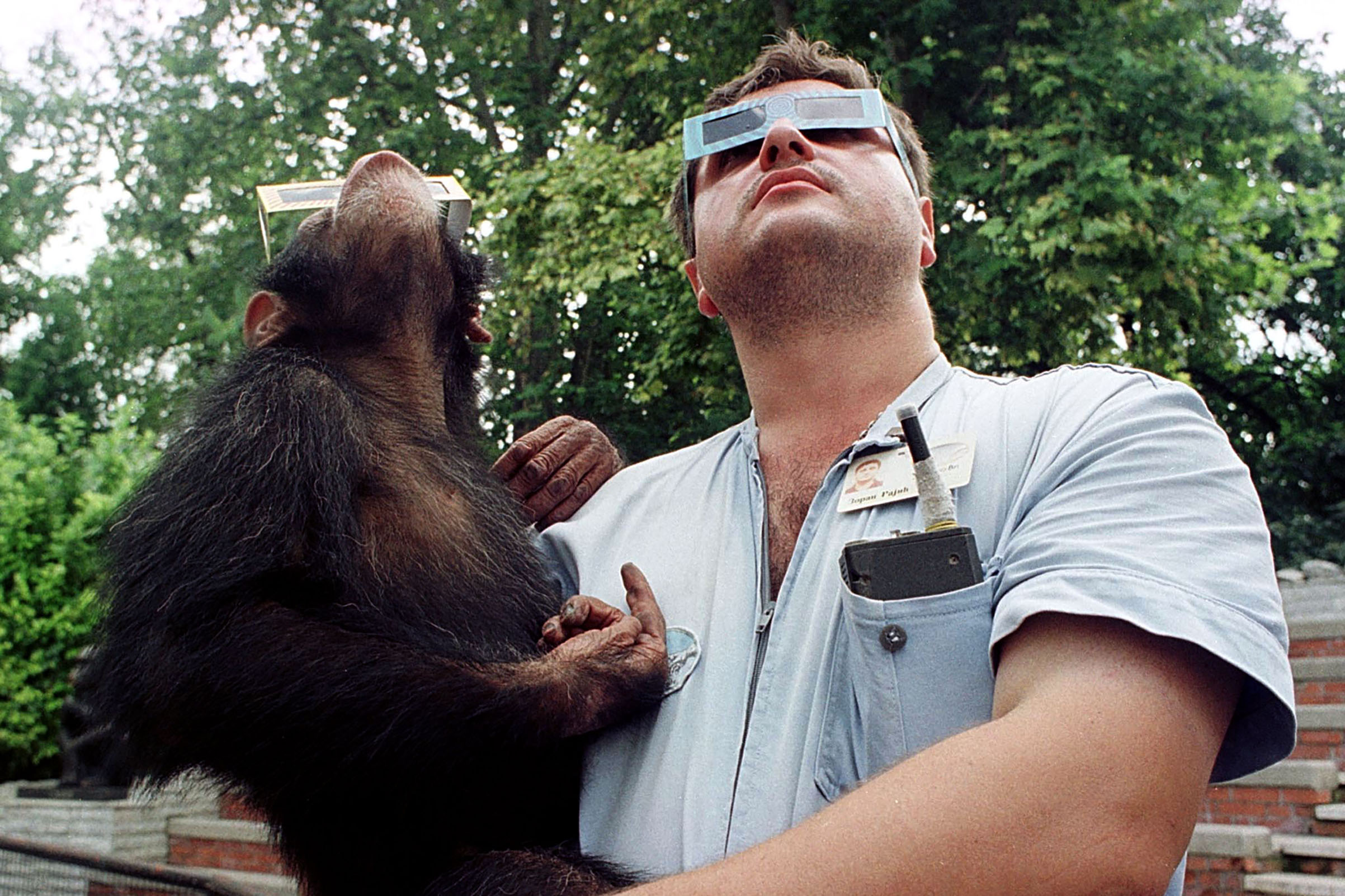
A Belgrade zookeeper holds a immature chimpanzee Olgica wearing solar viewing glasses while they look upwardly into the sky to watch the solar eclipse as it passes over the Yugoslav capital.
Reuters
The beliefs modify in animals during an eclipse has sparked the curiosity of scientists for centuries. It prompted primate researchers in Georgia to notice a group of chimpanzees during a 1984 annular solar eclipse, in which a bright ring of light was visible around the silhouette of the moon as information technology crosses in front of the sun.
The chimps, held in an outdoor compound at the Yerkes National Primate Research Middle in Georgia, exhibited signs of confusion, apparently showing they knew the celestial change was aberrant, according to a written report published in the American Journal of Primatology in 1986.
When the sunlight started dimming and the temperature began to drop, the animals climbed upward and positioned their faces and bodies toward the sun. "One juvenile stood upright and gestured in the direction of the dominicus and moon," the researchers wrote in the study.
When the eclipse passed and sunlight returned, the chimps climbed downwardly. "These information indicate that a solar eclipse, a rare and uncommon ecology consequence, tin can influence and modulate the behavior of chimpanzees," the study said.
READ More: Here'southward How Everyone in the U.S. Could Witness the Full Solar Eclipse in Person
The behaviors of dolphins, whales, chimpanzees and llamas are starkly unlike from what'south been observed in less intelligent animals, like bats, sheep and cows — which react to an eclipse the same mode they respond to nightfall.
In dozens of recorded instances, cows were seen at totality heading toward their barns, the mode they normally would effectually evening time. When the sunshine returned in under 3 minutes, the cows reversed form, even sometimes before reaching their barns, and went dorsum to the field.
Totality likewise moves swarms of honeybees to fly dwelling house, co-ordinate to a study published by the American Academy of Arts and Sciences in 1935. A team of researchers from the Boston Society of Natural History combined dozens of accounts from the public, game wardens and nature experts who witnessed the total solar eclipse in parts of Maine, New Hampshire and Massachusetts in August 1932.
Ane of the observers, who watched five hives, said: "As it darkened, the flying quickened and at the time of the greatest totality, the air was full of bees — a great roar of wings ensued and the entrances to the hives were blocked with bees trying to become in." The researchers said the insects' behavior is generally based on reflex — a response to rapid changes in light, temperature and humidity.

People use protective glasses on their dog during a partial solar eclipse in Liverpool on March 20, 2015.
PAUL ELLIS—AFP/Getty Images
The study likewise found well-nigh mammals in zoos rarely react to totality, except for Rhesus monkeys. Pet cats also showed no pregnant changes in beliefs, while some dogs expressed excitement or fear. Nevertheless, experts say the canines were most likely mirroring the reactions from their human companions.
"Doubtless in some instances, the intelligent animals sensed something unusual in the behavior of their masters, while probably others . . . reacted as if a thunderstorm were imminent and became frightened, whimpered or tried to hide away," the study said.
The total solar eclipse on Aug. 21 will cross America exclusively from coast to declension for the first time in U.Southward. history. Information technology's also the first total eclipse of the dominicus that will be visible from the contiguous U.Southward. since 1979. Well-nigh a dozen states are directly in the eclipse'southward path of totality, from Oregon to South Carolina.
Source: https://time.com/4882733/total-solar-eclipse-animals-react/
Posted by: machadodazint78.blogspot.com
0 Response to "Can An Animal Look At The Eclipse"
Post a Comment